Claude Fable 5 Is Out. Here's What Matters for Your Business.
On June 9, Anthropic released Claude Fable 5, its first publicly available Mythos-class model. If you've been tracking AI releases with increasing fatigue, this one is worth slowing down for — not because of the launch copy, but because the capability jump is real and there's a subscription logistics change coming June 23 that will catch teams off-guard.
What "Mythos-Class" Actually Means
Anthropic's model tier hierarchy has evolved well past a simple fast/smart split. Haiku handles quick, cheap tasks; Sonnet balances speed and depth; Opus handles complex reasoning. Mythos-class sits above all of them — it's a new ceiling. Until now, the only way to reach Mythos-tier capability was through a restricted Mythos Preview available to select enterprise customers at around $22 per million output tokens.
Fable 5 delivers the same underlying capability at $10 per million input tokens and $50 per million output tokens — exactly double the price of Claude Opus 4.8, but less than half the Mythos Preview cost. The full Claude Mythos 5 remains off-limits to the general public: it's available only to government agencies and critical-infrastructure partners, with its cybersecurity and research-biology restrictions lifted for those vetted use cases. Fable 5 is, in essence, the version the rest of us get — same engine, harder governor.
The Benchmark Story in Plain English
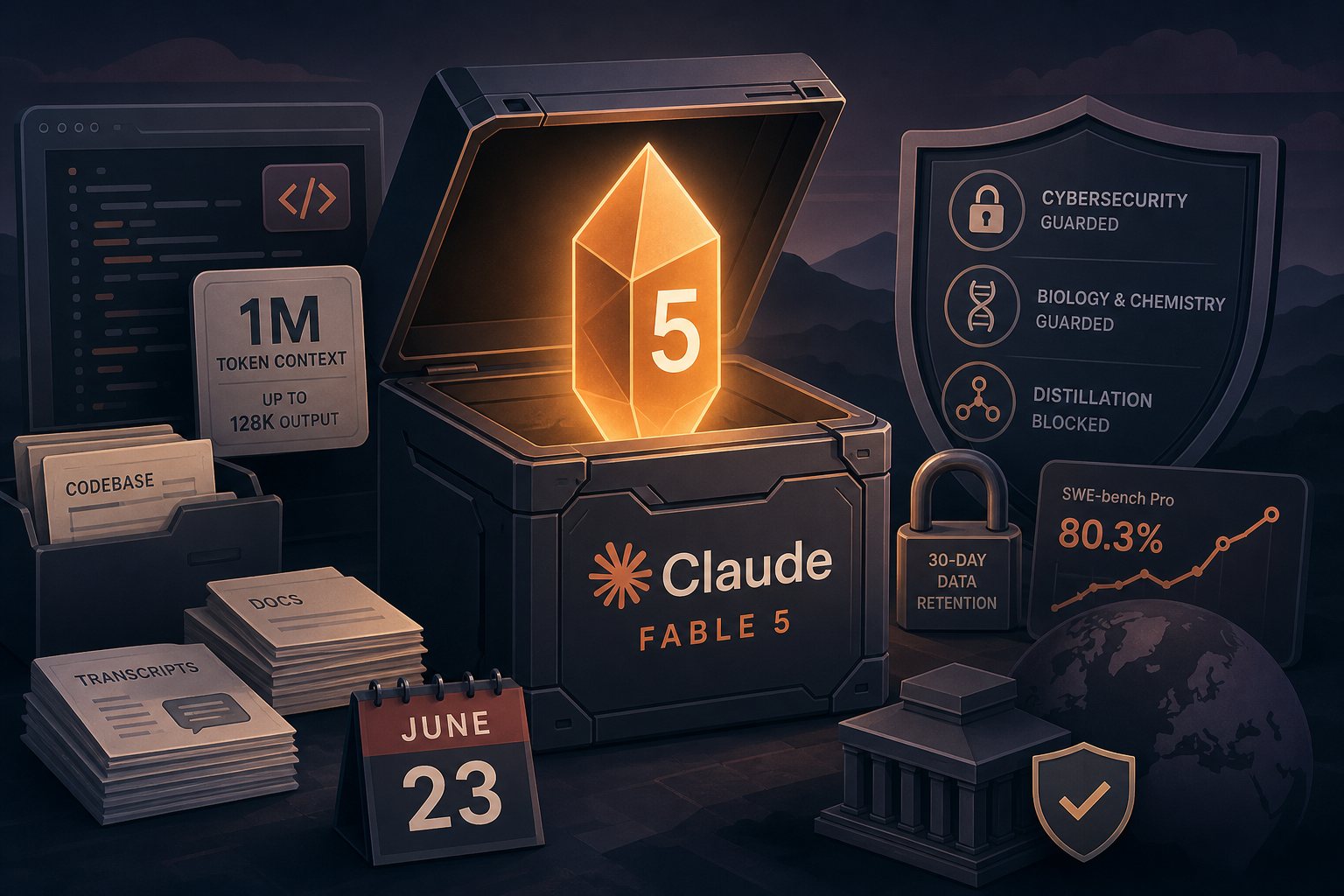
Fable 5 scored 80.3% on SWE-bench Pro, the industry's most demanding software-engineering benchmark — a set of real GitHub issues requiring autonomous fixes in genuine production codebases. The next-best public model, Claude Opus 4.8, sits at 69.2%. GPT-5.5 scored 58.6%; Gemini 3.1 Pro, 54.2%. An 11-point lead on SWE-bench Pro is not a rounding error at the frontier.
Analytics platform Hex reported Fable 5 as the first model to hit 90% on its core analytics benchmark. Developer Simon Willison, who tested Fable 5 extensively on the day of release, found it completed several days' worth of Python tooling work in a few hours — though that session also ran up $110 in API credits, a useful reality check on what "better" costs at usage-based pricing. The longer and more complex the task, the wider Fable 5's lead over prior models tends to be. For short, well-scoped prompts, the difference narrows considerably.
A Million Tokens Is Not Just a Big Number
Fable 5 supports a 1 million token context window with up to 128,000 output tokens. One million tokens is roughly 750,000 words — a mid-sized software codebase, hundreds of customer support transcripts, or a year of dense business documentation, all loaded into a single request. Tasks that previously required chunking pipelines, pre-processing, or retrieval-augmented generation workarounds can now be handled in a single pass. For developers doing large site migrations, multi-file code review, or deep document analysis, that simplifies the architecture meaningfully. The knowledge cutoff is January 2026.
A Deadline: June 23
If your team is on a Claude subscription, this matters. Through June 22, Fable 5 is included at no extra cost on Pro, Max, Team, and seat-based Enterprise plans. Starting June 23, those plans revert to Claude Opus 4.8 as the default; Fable access requires purchasing usage credits. Anthropic says it intends to restore Fable as a standard subscription feature as soon as capacity allows, but there's no committed date on that. If you have workflows or automations built against the subscription tier that now benefit from Fable-class performance, verify your plan before June 23 — or budget for the credit cost.
What the Guardrails Actually Do
Fable 5 has hard content gates that automatically fall back to Opus 4.8 — not a refusal error, but a silent reroute — in three categories: cybersecurity tasks (offensive operations, exploitation code generation), biology and chemistry queries that could provide dangerous-research uplift, and distillation attempts (prompts designed to extract or replicate the model's capabilities into a competing system). Anthropic ran an external red-team bug bounty across more than 1,000 hours of jailbreak testing and reported zero successful bypasses on the cybersecurity guardrails across 30 tested techniques.
For developers: if you're building agents that touch security scanning, vulnerability reporting, or gray-area web scraping territory, test your specific prompts. A silent reroute to Opus 4.8 means you get Opus-quality output at Opus pricing — so the billing impact is automatic — but you may not get the Fable-level depth you expected for that query. There's also a non-obvious data trade-off: Anthropic requires a mandatory 30-day data retention period on all Fable 5 API traffic to detect novel jailbreak patterns. If your workloads include sensitive business data, include that in your data-handling review before integrating.
Where Fable 5 Fits — and Where It Doesn't
For most small and mid-size businesses, the upgrade path is straightforward. If you're currently using Claude Opus 4.8 for coding, content generation, or agentic workflows and running into its limits — incomplete implementations, context overflow, weaker long-chain reasoning — Fable 5 is the logical next step. The cost is double, but on complex tasks the output quality justifies it for the right workloads.
If your use case is mostly short, well-defined requests — summarizing emails, fielding support queries, generating first-draft copy — Opus 4.8 or Sonnet remains the better cost-performance choice. Fable 5's advantages compound on complexity and length; for simple prompts, the premium isn't earned.
The larger story is the tier split itself. Anthropic publicly urged major AI labs to coordinate a slowdown on frontier development, then released a frontier model days later. That's not hypocrisy — it's the honest bind that any safety-focused lab faces when capability is also a competitive moat. Mythos 5 behind closed doors; Fable 5 for the rest of us. Understanding which tier your vendor is actually selling you — and what the governor is blocking — is now part of evaluating an AI tool, not an afterthought.
We've been running clients' AI integrations through their paces for a while now, and the recurring lesson is the same one that applies to hosting: the spec sheet matters less than knowing exactly what happens at the edge cases — and what the bill looks like when a workflow scales.